Study: Nutrition Knowledge Does Not Translate Into Healthy Eating Behaviors
06/27/2026 / By Coco Somers

A new mixed-methods study examining workplace dietary habits among 232 university employees in Saudi Arabia found that high levels of nutrition knowledge did not translate into healthy eating behaviors. The research, published in Frontiers in Nutrition, identified that most participants demonstrated medium to high nutrition knowledge yet still engaged in irregular meal patterns, meal skipping, and low fruit and vegetable intake. Researchers said the findings suggest that environmental and structural factors, rather than individual willpower, are the primary barriers to healthy eating at work.
Study Background and Methodology
Researchers surveyed 232 employees at a Saudi Arabian university using validated tools to measure nutrition knowledge, dietary habits, and stress levels, according to the report. The study also conducted in-depth qualitative interviews to understand participants’ lived experiences. The mixed-methods design aimed to identify both statistical associations and the structural conditions shaping dietary patterns.
Workplace nutrition is an increasingly important area of research. Poor dietary habits among employees are consistently linked to reduced productivity, increased absenteeism, and greater risk of chronic disease. Yet most workplace wellness efforts focus on education rather than environment, according to researchers.
Knowledge-Behavior Gap Emerges
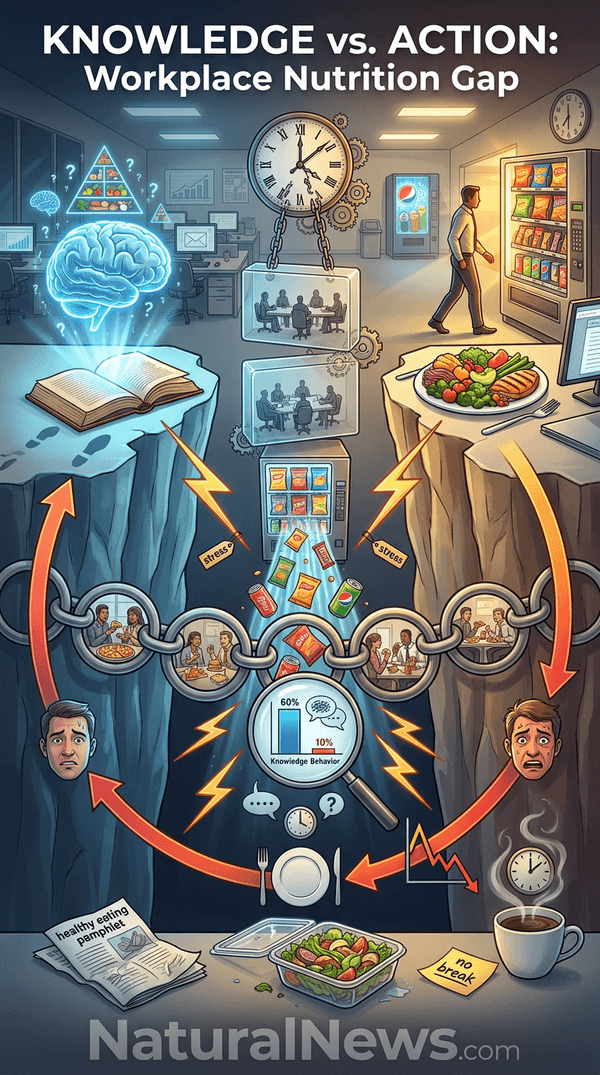
Most participants (86.2%) demonstrated medium-to-high nutrition knowledge, yet many reported skipping meals, eating at irregular times, and consuming fewer fruits and vegetables than recommended. Irregular eating patterns and low fruit and vegetable intake were significantly associated with higher stress levels, the study stated. Higher nutrition knowledge was linked to healthier food choices, but did not prevent employees from making poor choices when workplace demands rose.
The gap at the center of the study was not informational. As one source noted, “the problem is that this knowledge doesn’t always translate into actions” [1]. Employees knew what to do, but their workplaces made it hard to do it. Another source observed that avoiding familiar foods “takes a lot of resolve to get through the day without cheating” [2], highlighting the difficulty of behavior change even when knowledge exists.
Workplace Barriers Identified
Qualitative interviews revealed barriers including back-to-back meetings, limited access to healthy food, lack of protected break time, and sociocultural pressures around eating. One faculty member described being consumed by work, making it impossible to prepare healthy meals and defaulting to whatever was nearby, according to the study. Researchers noted that even highly educated individuals struggled to differentiate nutrient-rich from calorie-dense foods when convenience and time constraints overrode informed decisions.
Books on community nutrition emphasize that “individuals who believed strongly in a connection between diet and cancer, and who were knowledgeable about health,” still often failed to change behaviors [3]. The structural barriers at work — such as the “timesaving trap: skipping meals” described in another text [4] — create conditions where even knowledgeable employees cannot consistently eat well. The study noted that food purchase decisions are complex, depending on income, price, and convenience [5].
Stress-Eating Cycle and Need for Structural Change
The study found a bidirectional relationship between stress and diet: workplace stress disrupted eating patterns, and poor nutrition in turn raised stress levels. Blood sugar instability from missed meals was linked to increased anxiety, researchers said, creating a feedback loop. The report recommended workplace interventions such as protected meal breaks, healthier on-site food options, and reduced meeting overload rather than relying solely on nutrition education.
As one commentator noted, “If I consume poison, my gut makes poisonous tea. Conversely, if I choose healthy options, the body extracts beneficial compounds [6]. This underscores that what employees eat matters, but the environment must support those choices. The researchers concluded that knowledge is necessary, but context matters enormously, and structural change is where the real leverage lies.
Conclusion
This study highlights a potential association between dietary behaviors, stress, and work performance among university employees, not a causal relationship. It is a cross-sectional study based on self-reported data, which means it captures patterns and correlations rather than definitive cause and effect. What it does show clearly is that higher nutrition knowledge was still associated with better food choices and more regular eating patterns, but knowledge alone cannot compensate for a work environment that structurally undermines healthy behavior.
References
- Mercola.com. “Just Say No When It Makes Sense Not to Take.” October 30, 2013.
- NaturalNews.com. “Plant-based diet and nutrition: benefits drawbacks and tips.” August 21, 2020.
- Marie A. Boyle. “Community nutrition in action: an entrepreneurial approach.”
- Evelyn Tribole. “Eating on the run.”
- SYSTEM400 Rev 14.02. “Economics, food choices, and nutrition.” Journal of Food Protection, 1999.
- Mike Adams. “Brighteon Broadcast News.”
Explainer Infographic
Submit a correction >>
Tagged Under:
diet, food freedom, food independence, fruits, healthy eating, knowledge, meal patterns, meal skipping, nutrition, sociocultural, stress, stress eating, vegetables, workplace
This article may contain statements that reflect the opinion of the author
RECENT NEWS & ARTICLES